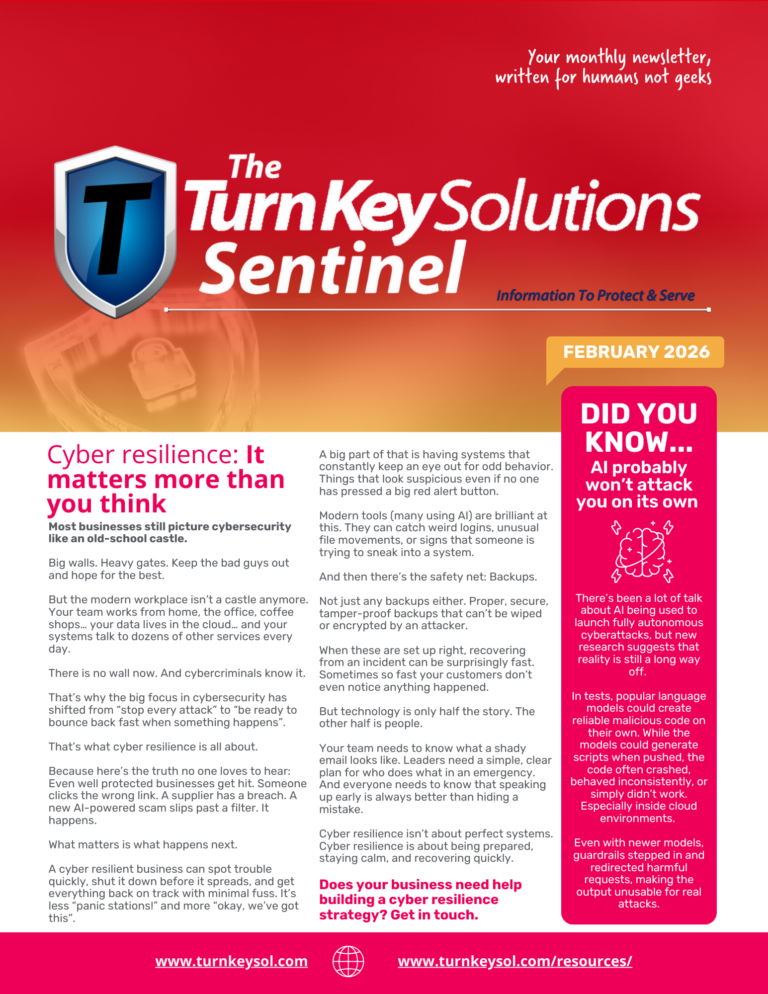

A New Year Offers the Perfect Moment to Refresh Your Security Strategy
The calendar has flipped to 2026, and while personal resolutions are top of mind, your business deserves its own fresh start, too. Cyber threats are evolving faster than ever, and for small and mid-sized businesses (SMBs), the stakes are high. A single breach can cost thousands, damage your reputation, and disrupt operations. The good news? A few smart changes now can set you up for a secure, productive year.
Why SMB Cybersecurity Resolutions Matter
SMBs are prime targets for cybercriminals because they often lack the layered defenses of larger enterprises. And the stakes couldn’t be higher. Without proper cybersecurity, SMBs face a cascade of operational, financial, and reputational risks that can be impossible to recover from.
For many small and midsize businesses, a single incident can trigger:
• Operational shutdowns:
Ransomware can freeze your entire business, from accounting systems to emails to customer databases. Many SMBs don’t have redundant systems or disaster recovery plans, so one incident can halt operations for days or weeks.
• Irreversible financial damage:
Between ransom payments, downtime costs, legal fees, compliance penalties, recovery services, and lost business, the average SMB breach can easily exceed six figures. Even a “minor” incident strains cash flow at a level most small businesses cannot absorb.
• Loss of customer trust:
Clients expect their financial data, personal information, and communications to be protected. Once trust is broken, it’s incredibly difficult to rebuild, especially for local businesses whose reputation is everything.
• Compliance violations and legal exposure:
Industries such as finance, accounting, healthcare, real estate, legal, and insurance face strict regulatory requirements. A breach can trigger fines, investigations, and mandatory disclosures that damage your brand for years.
• Increased cyber insurance premiums or canceled coverage:
Insurers now require MFA, backups, endpoint protection, and documented security processes. If an SMB can’t meet these requirements or suffers a breach because they failed to implement them, they may lose coverage entirely.
According to industry reports, nearly 60% of SMBs close within six months of a major cyberattack. Security is not simply an IT issue; it is essential for business survival.
Think of these resolutions as investments in resilience, trust, and growth, the building blocks that help your business operate confidently in 2026 and beyond.
Find out which IT mistakes are putting your business at risk.
Get your risk assessment today.
Running a small or midsize business today means managing more technology than ever before, yet many leaders still find themselves stretched thin and forced to make quick decisions without the full picture. That’s when cracks begin to form—cracks that cybercriminals are eager to exploit.
Most cybersecurity failures don’t happen because a business “doesn’t care,” but because owners are juggling operations, staffing, cash flow, and customer demands all at once. Unfortunately, even small oversights can snowball into major vulnerabilities.
To help you stay ahead of the risks, here are the top IT mistakes SMBs make and the practical steps you can take to fix them before they become costly problems.
Top 10 IT Mistakes Business Owners Make and How to Fix Them
1. Ignoring Software Updates
Outdated systems are an open door for hackers.
Fix: Automate patch management and schedule regular updates.
2. Poor Wi‑Fi Hygiene
Weak Wi‑Fi undermines all your other controls.
Fix: Use WPA3, rotate strong passphrases, disable WPS, separate guest networks/VLANs, and block peer‑to‑peer traffic.
3. No Employee Training
Human error is the #1 cause of breaches.
Fix: Host quarterly cybersecurity awareness sessions and phishing simulations.
4. Overlooking Backups
Data loss can cripple your business.
Fix: Invest in cloud-based and off-site backups with regular testing.
5. Assuming ‘It Won’t Happen to Us.’
Complacency is costly.
Fix: Schedule annual risk assessments and penetration testing.
6. Skipping Regular Policy Reviews
Policies written once and forgotten won’t match today’s threats.
Fix: Review and update IT/security policies semi‑annually; train staff on what changed and why.
7. Running End‑of‑Life Systems
Unsupported OS/firmware is low‑hanging fruit for attackers.
Fix: Establish lifecycle management, budget for refresh, and isolate legacy systems until replaced.
8. Flat, Unsegmented Networks
One compromised PC shouldn’t reach your crown jewels.
Fix: Segment networks (user/guest/servers/OT), lock down east‑west traffic, and implement least‑trust firewall rules.
9. Neglecting Email & Domain Security
Business email compromise (BEC) is still the #1 cash-out for attackers.
Fix: Turn on advanced phishing protection, enforce DMARC/DKIM/SPF, tag external senders, and sandbox attachments/links.
10. Shadow IT & Unvetted SaaS
Unsanctioned apps create hidden data leaks and compliance gaps.
Fix: Use app discovery/CASB, publish a sanctioned app catalog, and require quick security reviews before adoption.
Building strong fundamentals is the first step, but lasting security requires consistent habits that keep your defenses sharp throughout the year. These habits do not have to be complicated or time-consuming. When they become part of your routine, they strengthen your entire security posture and make your business far more prepared for the unexpected.
To help you begin the year with clarity and momentum, here is a list of security habits that every SMB should adopt.
Here’s Your 2026 SMB Security Resolution Checklist:
- Automate Updates & Patching
Enable automated OS/app updates and enforce monthly patch cycles across all devices and servers. - Lock Down Wi‑Fi
Migrate to WPA3, rotate strong passphrases, disable WPS, separate guest/VLAN networks, and block peer‑to‑peer traffic. - Train Employees Quarterly
Run cybersecurity awareness training and phishing simulations every quarter; track completion and phish‑click rates. - Harden Backups & Test Them
Implement cloud + off‑site backups (3‑2‑1 or better), enable immutability, and perform/test restores on a set schedule. - Schedule Risk Assessment & Pen Test
Commit to an annual third‑party assessment and penetration test; remediate findings with due dates and owners. - Review & Update Policies (Twice a Year)
Update IT and security policies semi‑annually and brief staff on what changed, why, and how to comply. - Retire End‑of‑Life Tech
Build a lifecycle plan and budget to replace unsupported OS/firmware; isolate any legacy systems until decommissioned. - Segment the Network
Separate users, servers, OT/IoT, and guest networks; restrict east‑west traffic with least‑trust firewall rules. - Secure Email & Your Domain
Turn on advanced anti‑phishing, enforce DMARC/DKIM/SPF, tag external senders, and sandbox links/attachments. - Control Shadow IT & SaaS
Use app discovery/CASB, publish a sanctioned app catalog, and require quick security reviews before new tools get data.
These habits are more than preventative measures. They build confidence and trust with your clients by showing that you take their data and your operations seriously.
Once these habits are in place, the next step is to make sure your technology is working for you and not holding you back. The right tools can reduce risk, improve productivity, and give your team a stronger foundation for growth.
This is where thoughtful technology upgrades can make a major difference in both your security and your day-to-day operations.
Ready to Make 2026 Your Most Secure Year Yet?
Start strong with a simple SMB Security Audit today.
Let’s make your business breach-proof, because peace of mind is the ultimate ROI.
Fresh Tech for a Fresh Start
Technology is your ally in staying secure and competitive. Consider:
- AI-driven threat detection for real-time alerts.
- Managed IT services to scale without stress.
- Cloud migration for flexibility and disaster recovery.
These solutions are cost-effective and future-proof, giving SMBs the edge they need in a fast-changing digital landscape.
When you pair smart habits with the right technology, you create a security strategy that is steady, adaptable, and ready for whatever the year brings. This combination allows your business to respond quickly to threats, protect valuable data, and maintain the trust of your customers. With the right focus and tools, 2026 can be your strongest and most secure year yet.